


Project “Ne (nez)gligez pas la famille!” i.e. “Do not neglect family“
First winning project in the 2024 educational research awards from “5 senses for kids Foundation”.
A project by the WINUKO Association
How did this idea come about?
As the mother of three children, I’ve noticed that time is precious and flies by.
Every moment counts during childhood to strengthen the bond between children
and their parents.
Today’s parents can find it difficult to reconcile their professional and family lives. It can even be difficult for them to find the time to enjoy time with their children.
Through the workshops we offer, we want to provide spaces and moments where parents and children can create quality moments that they can also reproduce at home.
Project objectives
The aim is to enable the families taking part in the workshops to create, establish and renew quality time together, and to ensure that they leave with information, practical tools, advice and knowledge about well-being. A communication through the senses, which will strengthen the links once they are at home.
The “Né(e)_sens” workshops
. The aim of the “Né(e)_sens” workshops is to stimulate the senses of touch and smell, to introduce young and old alike to the culture of well-being and the olfactory domain.
. The sense of touch, combined with a moment of comfort and cocooning, will be the focus of a workshop where massage will forge links to (re)discover each other as a family, redefining the unique bond that links children to their parents.
. Participants will be invited to create family moments where the senses define the quality of the time spent together and recall the encounter of the first day of … birth. All this under the watchful eye and guidance of a family well-being professional, trained in naturopathy and massage therapy. This professional will lead, train and pass on meaningful massage techniques.
The “Nez_sens” workshop
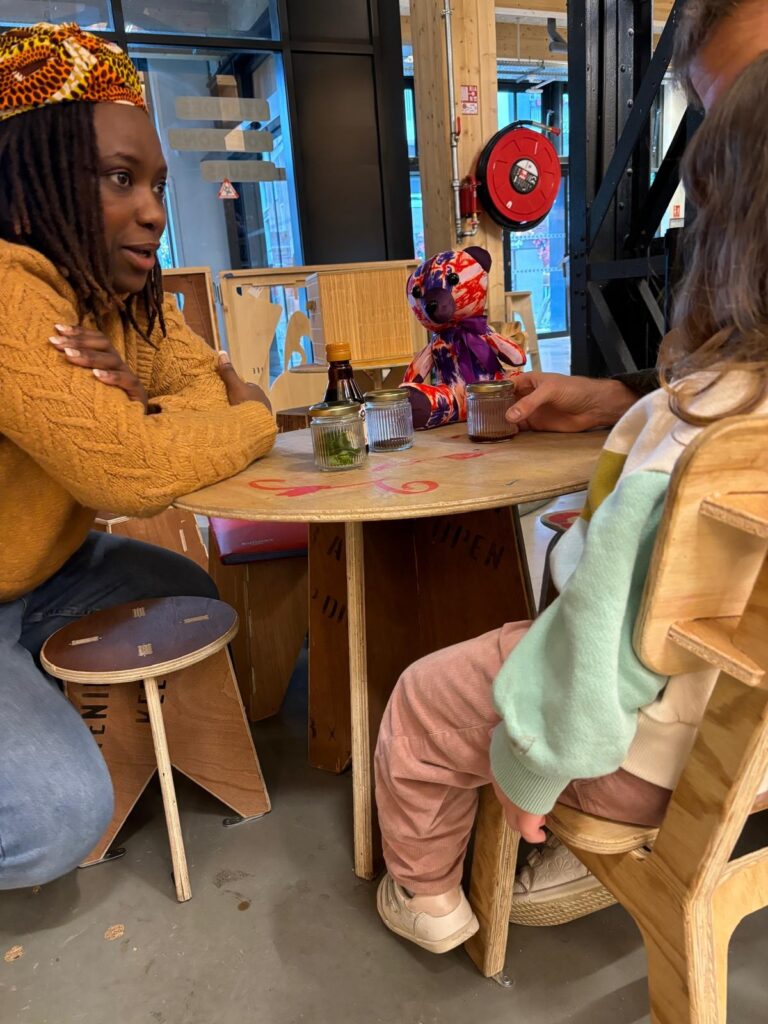
The second “Nez_sens” workshop will involve the sense of smell, inviting each child to explore the different smells in their environment (at home, outdoors) with the aim of identifying, guessing and naming them.
This workshop develops other psycho-cognitive and psycho-social skills such as :
curiosity, concentration, memory, attention and, ultimately, language, because each child will then have to communicate by formalising the discovery of the smell, and sharing what it evokes in them.
The fun “nose-sense” workshop is a way for children to get to know themselves and their environment through their sense of smell.
Impacts
This project will run from January to June 2025. Each workshop is made up of 6 children and one accompanying parent.
A satisfaction questionnaire is administered at the end of each workshop to measure the impact of the massages (“What do you feel?” workshop) and the child’s ability to appreciate the power of the olfactory sense (“What do you smell?” workshop).
There are three distinct categories that are measured by feedback from parents and children in family interaction:
Olfactory impact:
Post-workshop follow-up with a questionnaire sent to parents to measure changes in the development of the children’s sense of smell one month after the workshop and to determine whether the child is :
More sensitive to smells?
Are children better able to identify places in the home or in their immediate environment (school, classroom)?
Do children develop an olfactory awareness with greater curiosity? Are they more attracted to the olfactory component of their environment? Do they have a sharper sense of smell?
Identify the places and times when the olfactory sense can be called upon: nature (park, forest, family garden), on holiday (sea or countryside), a season (summer rain), a moment of pleasure (e.g. the smell of a Christmas tree, gingerbread, cakes, jam).
Memory impact :
Associating smells with memory and creating memories through smells.
Create a scent notebook write in a notebook what a smell reminds us of (a family member, a place, a moment, a season).
Example of an activity to collect smells : stick a leaf from a tree in the notebook, associating the smell of the leaf with where it comes from (the forest in this example).
Play this game with different objects, using the smell to recall a place, and therefore indirectly to create a family memory.
Emotional impact :
Measure how odours can arouse and/or be linked to an emotion.
The olfactory sense is all the more worth measuring because it can also be linked to danger (the smell of burning) or warn us of a problem (expired food that is no longer fit to eat).
For example: we can feel fear when we smell something burning, and we feel joy and/or a sense of security when we smell a cuddly toy, or the scent of mum or dad.
Example of an activity that can be measured: write down or formalise orally all the emotions we feel when we smell a scent, analyse the reaction to this scent (caution, affection, etc.).
Smells are the common thread that connects children’s family and social interactions with their socio-cultural environment, and they play a part in the development of their emotional intelligence.
Strengthening the parent-child bond
As part of the organisation of a Parenthood Festival planned for the second half of 2025 at the “Cité Fertile”.
Through workshops, WINUKO offers spaces and moments where parents and children can create quality moments that they can reproduce at home.