


Interview with Josette Serres – Part 3 (final Part)
Josette Serres, hello and thank you for agreeing to this series of interviews. As a doctor of developmental psychology, a former research engineer at the CNRS, and a specialist in neuroscience, you have also written several books and articles.
We will devote this third and final interview to the fact that babies are social beings and possess numerous means of communication. The subject of emotions will also form part of this interview.
When a baby communicates with adults, what are their means of communication and how should we interpret them?
The evolution of a human infant’s modes of communication from birth serves as a reminder of our origins. Language is a product of evolution. Researchers find in child development (ontogenesis) a model suited to the study of human evolution (phylogenesis).
We are social beings, and sensitivity to language emerges at the same time as we begin to communicate.
In utero, the baby perceives sounds, memorises them and can thus recognise its mother at birth simply by the sound of her voice.
Their birth will attract curious onlookers. Faces will lean over their cot and the exchange of smiles will begin. Mirror neurons are activated and the baby will mimic the facial expressions of adults, who in turn will also imitate the baby. The first conversational exchanges begin. Adults adapt their posture and language to attract the baby’s attention; this is ‘baby talk’. They speak slowly, repeat words and favour high frequencies (high-pitched sounds) which are better perceived by babies. This language is universal. These are proto-conversations. We are not yet talking about politics or philosophy. The content is irrelevant, but the form is there. Adults invite the baby into an exchange where each takes their turn to speak. Coordination begins to take shape. Brain waves synchronise. A rhythm is established. Each picks up the other’s rhythm. It is common to see the baby pedalling in time with the mother’s singing. It is unclear who is imitating whom! These precursors to language were theorised by Bruner, who speaks of ‘formats’ to account for the need to teach the baby the basic rules.
During the first 3 months, the baby listens to adults speaking to them, but they pay particular attention to visual cues on the face. They are drawn to direct eye contact rather than a sidelong glance. They are drawn to a smiling face and react negatively to an angry one. Studies show babies’ early ability to deduce adults’ intentions.
Around 6 months, the baby’s interests change. Now able to grasp objects, they will handle things a lot and focus on them. Their mother will get less attention from them!
Around 8 or 9 months, interactions between the baby and adults become more structured. The child never tires of the game of ‘ping-pong’: ‘I give to you, you give to me’! To follow the game, both must share the same interest in the same object. This stage is called ‘joint attention’. The baby then becomes able to follow the adult’s gaze, deduce what interests them and share that interest. This skill works both ways. Meanwhile, they babble and listen to themselves. We say they’re practising their scales!
Around 12 months, to draw the adult’s attention to what interests them, the baby may use pointing and vocalisations. By inviting the adult to look in the same direction, the baby makes a proto-declarative pointing gesture that will later be translated into ‘did you see that?’. They may also use ‘pointing’ to draw the adult’s attention to a desired object, and the same gesture will become a proto-imperative pointing gesture that will translate into spoken language as ‘I want that!’. Gesture precedes language. Many babies point with their index finger, but this is not universal. Relying on an adult to get something is a good idea, but one still needs to know how to make oneself understood.
Within a year, the baby has learnt the basics, and above all how to adapt to the person they are communicating with. Adults have put into words what the baby was doing, and now it is the baby’s turn to talk about what interests them.

Over the course of a year, the baby has gathered all the sounds heard in their environment and is beginning to produce them, but this production takes place within a context of interaction and follows the format taught by adults: ensuring a shared interest. It’s not every man for himself! The baby and their conversation partners will discuss various topics, but by constantly adapting to one another. Everyone is a novice at this task. The baby, certainly, but also the adults, who do not always understand the baby’s language. Sometimes, there will be misunderstandings. It will be necessary to repeat, rephrase, make compromises, and not speak at the same time. This ‘tuning in’ so dear to Stern resembles what musicians do before starting a concert to ‘warm up’ their instruments.
Around 16 months, verbal and non-verbal language begins to develop. It is easy to see what is most effective for making oneself understood. Progress in language will force the child to adapt to a new form of communication.
Around 18 months, the baby, who loves to possess objects, enjoys talking about them. It is a good topic of conversation. It also marks the beginning of awareness of others, and meeting other children encourages them to share games. Children start with gestural language such as synchronous imitation (doing the same thing), then move on to verbal language to take turns: “your turn, my turn!”
Around the age of 2, the child will assert their need to own objects and will exclaim “it’s mine!”. They enter the normal ‘NO’ phase of opposition.
Now they have their whole life ahead of them to refine this system and, depending on their temperament, become a chatterbox or a quiet type!

When communicating with young children, we also talk a lot about joint attention. Can you explain what this is, and what the implications are?
From birth, a baby is capable of attention and knows how to direct their gaze towards objects as they gain better and better control of their saccadic eye movements. They are also strongly drawn to eyes. They can follow their movements thanks to their mirror neurons, which encode movement. During interactions with adults, the analysis of gaze direction forms part of the communication system. It indicates where to look, but above all why to look. It is a sharing of interest and, above all, a way of guessing what interests the other person, of putting oneself in their shoes. A glance says more than we realise.
Finally, what is the role of synchronisation in interactions?
Following Stern, the concept of attunement has sparked much reflection. Babies’ ability to synchronise with their human environment helps us understand that they construct time within dynamic interaction. The mother and her baby use a rhythmic pulse to anticipate each other’s expressions, but also, and above all, to play with the rhythm. When attunement difficulties arise, we must observe the dyad that is unable to synchronise and identify the factors that may be contributing from either party: whether it be a mother suffering from depression, or a baby exhibiting autistic traits, etc.

What is the link between young children’s emotions and their communication?
Emotions are a language that expresses mental states. The child must learn to express clearly what they are feeling, and parents must make an effort to understand.
Emotions are instinctive reactions produced by the brain to strengthen the bond with parents (crying and smiling) or to avoid danger (surprise and disgust).
Babies can distinguish between these different expressions but do not understand the mental states of those expressing them. When a young child bites a ‘peer’, they do not realise that the other child is crying because they are in pain (the child themselves has not felt any pain).
Adults’ responses guide the child in refining their reactions.
Distress turns into anger to be more effective.
We must help the child recognise emotions using the appropriate vocabulary.
We need to find games to act out emotions (pretend play).
We must support these emotions to replace the lack of control over the COF.
A comforted baby regulates their emotions better as an adult.

How can we take this lack of emotional control into account to best support very young children?
All emotions play a part in communication and are a means of conveying information, or even amplifying a signal. It is therefore important to interpret them correctly.
Let’s first talk about the origin of emotions:
Emotions predate language but have evolved to enrich communication.
Emotions such as disgust and fear are essential for warning others of potential danger. Surprise encourages others to come and share a discovery. Emotions such as joy, sadness or anger alert others to our mental state and our availability. Thanks to our capacity for empathy, we can draw closer to those who are joyful or sad, but distance ourselves from those who are angry.
Next, the child’s aim is to make themselves understood:
Young children test their emotions by analysing adults’ responses. If the response is not appropriate, they refine the message (by exaggerating).
Adults have the skills to understand these messages. They must know how to decode them even when the message is not very clear. Parents and children must work together to improve communication. Adults can name the child’s emotions to help them identify them.
Through our mirror neurons, we also reflect the image of the perceived emotion, as if seeking confirmation.
Crying is not an emotion but a physiological response to an emotion of psychological or physiological origin. It is unique to humans. Crying causes us to produce endorphins, which are natural painkillers.
So, an important question to conclude this series of interviews with you: how should adults deal with a baby’s crying?
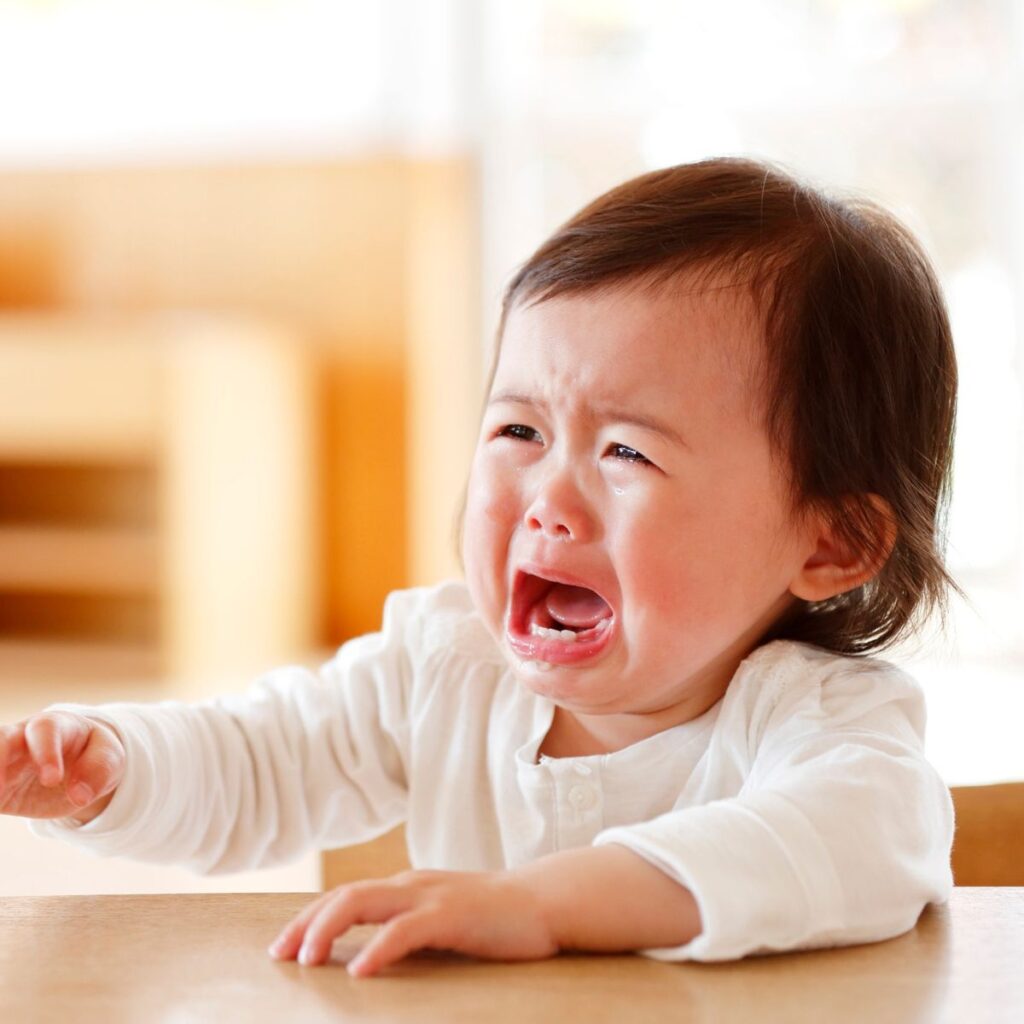
A child needs to feel that they can rely on adults to help them find their calm again. A toddler who is left to cry learns that they are being abandoned just when they need help. If they are left screaming in their room, a significant surge of stress hormones floods their brain: it continuously produces cortisol, like a central heating system that has gone haywire. If it lasts too long, crying is potentially dangerous because cortisol levels can reach a toxic threshold capable of damaging the brain. Comforting a child means finding the switch to stop this process. Crying is a mechanism for releasing cortisol: traces of it can be found in tears. You should therefore not try to stop the crying by telling the child to stop, nor by popping a dummy into their mouth without warning! But you must comfort them to help reduce cortisol secretion. You must stay close to them, hold them in your arms, and speak to them gently. Physical closeness triggers the release of oxytocin, the hormone associated with attachment and a sense of security. It is true that a child left to cry in the evening will eventually fall asleep. This is not a victory. The toddler becomes discouraged and loses their enthusiasm. As their brain stops releasing hormones that provide a sense of well-being, we must find a way to restart the process. Comforting a crying child helps to activate their vagus nerve, located in the brainstem. This nerve, nicknamed ‘the vagabond’, regulates the functioning of the body’s main organs and rebalances the digestive system, heart rate, breathing and the immune system. By comforting the child, we help to strengthen their vagus nerve so that it can play a soothing and regulating role. Cuddles accelerate the maturation of the emotional system.

Thank you, Josette Serre!
End of the third part of this interview
To read Part 1, click here, and to read Part 2 , click here.