


Interview with Hélène Fournier
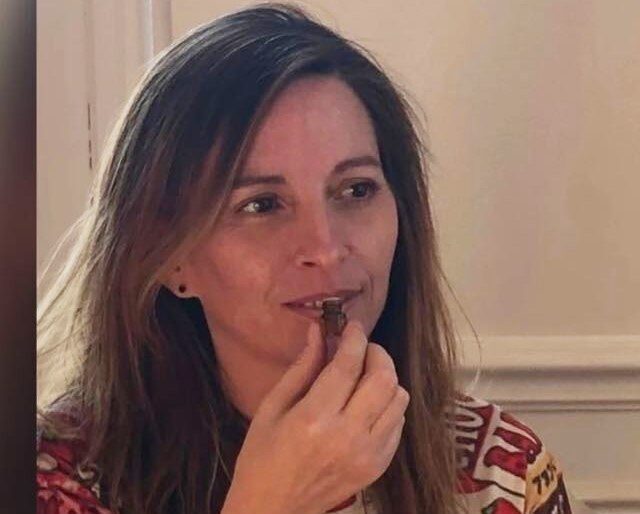
Hello Hélène Fournier
To begin this interview, could you please introduce yourself in a few words?
For over fifteen years, I’ve been weaving bridges between words and people, a “French as a Foreign Language” trainer. This profession has enabled me to pass on my knowledge and provide support in a variety of intercultural contexts to people of all ages.
What’s more, I’ve always been fascinated by the world of scents and their evocative power. This olfactory sensibility has naturally led me down another path of transmission: that of olfactory workshops, which I happily lead to awaken the senses, revive memories and explore emotions through scents.
Committed to sharing, teaching and well-being, I’m also secretary of the association “Nez en Herbe”, which promotes the sensory, educational and, for my part, therapeutic uses of essential oils with children and sometimes adults.
To deepen my practice, I trained in olfactotherapy at “EFAI” (École Française d’Aromathérapie Intégrative). This gentle, subtle approach enables me to work on emotions, memory and otherness through scents.
Today, I combine my two worlds: pedagogy and olfaction, to offer sensitive and creative support based on language, the senses and presence with oneself and others,
Have there been any milestones in your career?
My path has always been guided by two impulses: the desire to pass on knowledge and the call of the senses.
For more than fifteen years, I taught French to those who wanted to use it as a language of welcome, love or future. I practiced this profession with passion, listening attentively and being curious about others. But as time went by, I felt the desire for a more intuitive, more sensory way of transmitting, one that didn’t always involve words.
Ever since I was a child, smells have been with me like inner markers: they move me, tell me stories, connect me. This invisible power has always fascinated me. It was this power that led me to the world of essential oils, and in particular to conscious olfaction, and then to olfactotherapy, where I found another way of saying, listening and soothing.
Creating olfactory workshops, getting involved with the Nez en Herbe association, training in EFAI… all this came naturally, as if my career as a trainer had found a second wind, in another language: that of the nose, the heart and memory.

What kind of olfactory support do you provide, starting with adults?
I work with adults in three different contexts: in a group well-being workshop, in an educational and cultural setting, and in an individual session with personal olfactotherapy support.
- In a group well-being workshop
The aim is to do just that! To offer a moment of relaxation, sensory reconnection and personal expression.
In these workshops, I invite participants to slow down, breathe and feel. After a time of anchoring and breathing, we set off to discover a few essential oils, known or unknown, chosen for their soothing, inspiring or regenerating qualities.
Everyone is free to enjoy the experience in their own way: some close their eyes, others take notes or draw their feelings.
The workshop can end with a time of sharing, a simple ritual sharing emotions or memories, the making of a personalized stick or an invitation to a short moment of concentration with an oil chosen individually during the session.
The atmosphere is gentle and friendly, conducive to relaxation and inner listening, and where the emergence of emotions is welcomed with kindness.
- In an educational or cultural setting in a media library, school or association
This time, the aim is to awaken curiosity and stimulate the imagination by combining the senses and language, linking olfaction to living, sensory teaching.
I offer workshops in which scents become a medium for expression, creation or storytelling. This can take the form of a variety of olfactory games, scent-based storytelling, sensory writing workshops, or an introduction to the vocabulary of emotions through the sense of smell.
These activities are particularly suited to “French as a Foreign Language” audiences, young people and adults looking for a fun, sensitive approach to language. They can also form part of artistic, intercultural and/or intergenerational projects.
- Individual sessions with olfactotherapy or sensitive accompaniment
The aim is to accompany the person on a personal journey through scents.
In individual sessions, I offer a time of listening and presence, exploring essential oils as a means of emotional exploration and reconnecting with oneself…
I use carefully chosen oils, in line with what the person is going through: a moment of fatigue, grief, transition, a quest for meaning, emotional overload..
The person inhales a selection of scents blindly, in complete safety, and I accompany them in welcoming the sensations, images and emotions that emerge.
It’s a gentle, confidential space that respects each individual’s rhythm. Depending on the session, I may suggest a fortnight’s “work” with an oil that has particularly sensitized the person during the session.
And how do you work with children?

I propose a sensory, playful and caring approach that respects their natural rhythm of discovery and their immense capacity for wonder.
I design my workshops as olfactory journeys: we explore scents, play with emotions, observe what the nose tells us… No pressure, no expectation of performance, just curiosity and pleasure.
Each session begins with a little ritual (breathing, concentration game, song, talking circle) to create a climate of trust and a reassuring framework.
Depending on the age of the child, I use adapted olfactory games developed by the Nez en Herbe team. For example, what’s the same/not the same? What smells alert us to potential danger? Which smells, if possible seasonal, are familiar or unfamiliar? I also use memory games such as “Kim” smells, not forgetting flavors that cannot be identified without a sense of smell!
There are also moments for free expression, where the spoken word takes on its full meaning. Very often, children recount their experiences and memories according to the odorant proposed.
As with adults, I propose simple creations: emotional sticks or olfactory “doudou”, or even little scent notebooks, depending on the child’s age and personality, and the project that has been determined in advance with the school or association.

You’ve shared with us some of your objectives when working with adults. But what are your objectives when working with children?
The aim is not just to “make people smell”, but rather to help children use their sense of smell, and get to know themselves better through their senses: learning to listen to their body, recognize their emotions, express their feelings, but also to make contact with others.
When I work with organizations (schools, media libraries, leisure centers), I always take care to adapt my proposals to the age, context and specific needs of the group. I also like to integrate a pedagogical or educational dimension with a specific vocabulary, awakening to nature, using olfactory functions…
And above all, I make sure that the children come away smiling, a little closer to themselves, and with their noses wide awake! To do this, for example, follow the workshop with a lunch or snack where the sense of smell will be put to greater use.
For children under three, olfactory awakening is very well suited to activities designed to awaken the sense of smell in young children.
To take one example, I’ve observed that by letting little ones smell Peruvian Balm when they were impatient to be breastfed, it was possible to direct their attraction towards the proposed scent and also bring about a significant degree of soothing.
And to conclude, what can you say about olfaction?
In various educational, associative and cultural contexts, olfaction undeniably opens up a gentle, respectful and natural gateway to discovering oneself, others and the world around us.
From birth to the autumn of life, this sense, often cited to evoke the vivid or gripping memories recounted by poets, is sorely lacking in educational programs and deserves to be explored more fully from an early age. So don’t hesitate to give your children a taste of it!