Interview with Stéphanie Cocardon
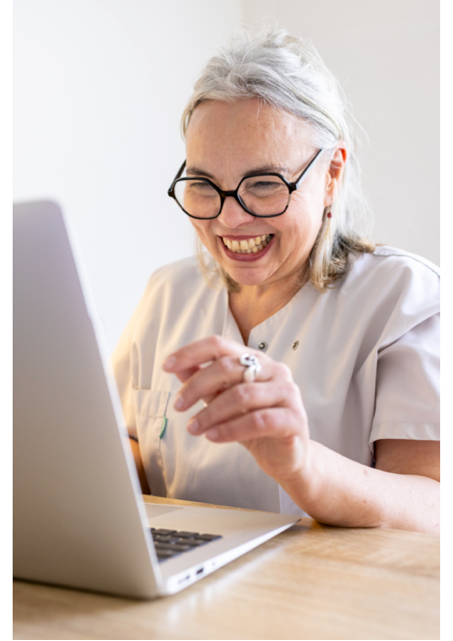
Hello, Stéphanie Cocardon. You are an osteopath (D.O.) and are certified in Perinatal and Paediatric Osteopathy, as well as in General Movements (GMs) Assessment. We are delighted to be interviewing you today to find out more about the role an osteopath can play in supporting babies.
Could you introduce yourself and tell us about your experience working with babies?
I have been an osteopath since 2013, following a career change that began with the birth of my second child. As soon as I obtained my qualification, awarded by a school accredited by the Department of Health, I wanted to specialise in supporting babies and young children. I soon realised that my initial training did not provide me with all the knowledge needed to support this very specific group. I therefore undertook a three-year course in Perinatal and Paediatric Osteopathy with Roselyne Lalauze-Pol, a leading authority in this field, in order to deepen my knowledge and refine my practice of examining babies.
A few years later, I felt the need to gain a better understanding of the baby’s development as a whole. This led me to enrol on the University Diploma in the Cognitive and Social Development of the Baby at Paris Cité University, led by Joëlle Provasi and Emmanuel Devouche. This diploma profoundly transformed my perspective by introducing me to the major advances in research on infant development over the last few decades.
It was also in this context that my desire to explore the observation of babies’ spontaneous and reflex motor skills in greater depth arose. I therefore obtained certification in Professor H. Prechtl’s General Movements assessment, a method for observing infants’ spontaneous motor skills that is recognised for its value in the study of neurodevelopment. More recently, I undertook training in T. Berry Brazelton’s Neonatal Behavioural Assessment Scale (NBAS), which enables the observation of a newborn’s skills, reflexes, self-regulatory abilities and interactions with those around them. Today, observing the baby – their skills, motor skills and developmental trajectory – is central to my practice
What reasons do parents have for consulting you?
During the first few weeks of life, consultations often centre on difficulties specific to this period of adaptation to life outside the womb: breastfeeding and the baby’s sucking, their muscle tone, posture, digestive problems, crying, sleep, as well as cranial deformities, a blocked tear duct or a postnatal assessment. Later on, parents seek advice for persistent plagiocephaly, a delay or asymmetry in certain motor skills—such as unilateral rolling over, an inability to sit unaided, the absence or atypical nature of crawling, or a delay in walking unaided. Around the age of three or four, consultations tend to focus more on ENT and maxillofacial issues linked to sleep disorders and posture. Parents sometimes also seek our advice regarding clumsiness or difficulties with coordination.
Each stage of development brings its own set of questions and new challenges.
In practical terms, how does a consultation with a baby actually take place?
The consultation begins with a discussion and a series of questions with the parents. I also review the health record, which is an important source of information. I then observe the baby: in their parents’ arms, on the examination table or on the floor if they are older. This stage allows me to assess their posture, their spontaneous or voluntary motor skills (depending on their age), their interactions with their environment, as well as their ability to adapt and self-regulate. By ‘regulation’, I mean the baby’s ability to regain their composure after a disturbance and to become receptive to their surroundings once more, as well as the level of support they need to achieve this.
Next comes the examination, which comprises two parts: a neurological assessment, largely based on the examination methods of Claudine Amiel-Tison and T. B. Brazelton, followed by an osteopathic assessment.
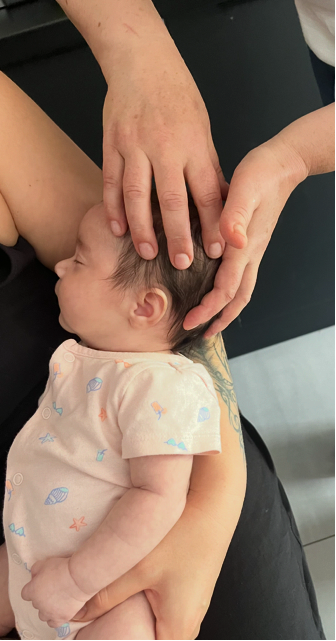
In particular, I assess cervical mobility, pelvic mobility, and mobility of the upper and lower limbs, followed by the overall alignment of the spine, and finally sucking reflexes and cranial sutures. The treatment is carried out using gentle techniques, constantly adapted to the baby’s reactions and in accordance with best practice and ethical guidelines.
I pay particular attention to the child’s emotional comfort. Before placing my hands on the baby, I explain who I am and what I am going to do; I encourage parents to stay close by, to talk to their baby and to play an active part in the consultation. In all cases, priority is given to the baby’s safety, comfort and natural rhythm.
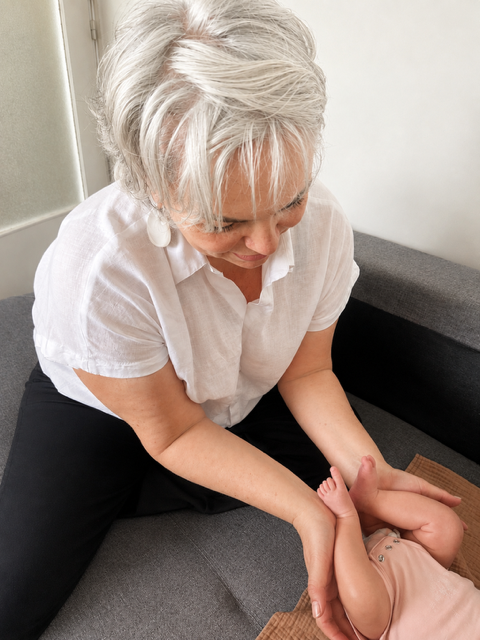
Osteopaths play a special role in supporting babies, as their practice involves observing babies from the general population, often at a very early age and at the parents’ initiative. Their consultations provide a special opportunity for dialogue, during which parents can share their observations, concerns and intuitions, whilst the baby has the space needed to express all their abilities. Furthermore, their assessment focuses directly on motor skills, and their manual treatment addresses the constraints that may hinder them.
However, we now know that motor skills are not merely a question of movement. They act as a key organiser of development, enabling the baby to explore their environment, enrich their sensory experiences, build their learning and gradually form relationships with others.
This unique position thus enables the osteopath to address functional difficulties falling within their field of expertise at an early stage. It also allows them to refer patients to other healthcare professionals for further assessment when development appears to be following an atypical trajectory. The child can thus benefit from tailored support as early as possible. This approach is never a substitute for consultations with a GP or paediatrician.
What message would you like to convey to parents and professionals who care for babies?
The main message I’d like to convey is that babies are far more capable than we often imagine. From the very first days of life, they communicate, interact, adapt and actively participate in their own development.
The therapist’s role is also to create the right conditions for this potential to be expressed, and to step back in the face of the power of the interaction between the baby and their parents.
I remember a newborn I was assessing using the NBAS. When it came to the automatic walking stage, I lifted him up and saw his feet crossing sharply inwards: I genuinely wondered how he was going to manage. His mother, seeing this, called him by his first name to encourage him. And this tiny baby, with a visible effort, uncrossed his feet by himself and moved towards her. His mother was deeply moved.
So, I would advise parents to take the time to watch their baby and to trust their own observations and instincts. They are the first to witness their child’s day-to-day development, and their concerns and intuitions always deserve to be heard.
And finally, to professionals, I would like to emphasise the importance of pooling our perspectives and expertise for the child’s benefit. It is often through this collaboration that the best decisions are made to support the baby’s development and assist their family.