


Spotlight on A3 Magazine: the journal of the Association of CNRS Alumni and Friends

Hello, Véronique Machelon
You are the Editor-in-Chief of A3 Magazine
Could you briefly introduce the Association of CNRS (Centre National e la Recherche Scientifique/ French National Centre for Scientific Research) Alumni and Friends?
The Association of CNRS Alumni and Friends (A3 CNRS) works to promote the CNRS by bringing together a dynamic and committed community passionate about science and discovery. Founded in 1990, this association enables everyone who has worked at the CNRS – often throughout their entire career – to maintain a valuable connection with the institution and to help raise its profile. The association is also open to anyone wishing to develop a special relationship with the scientific community and to nurture their curiosity about research.
How do you see the role and mission of A3 Magazine?
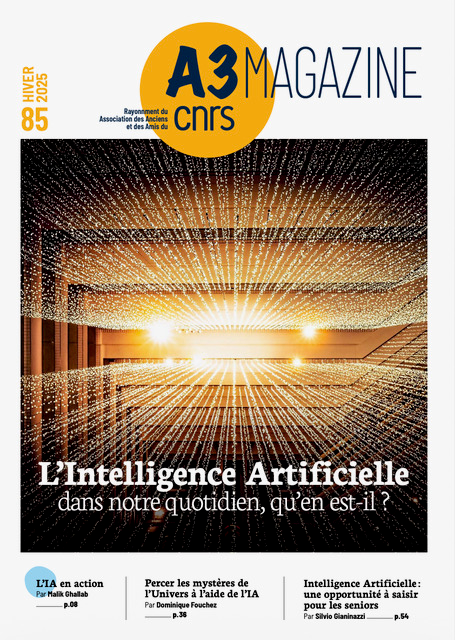
To foster dialogue and build bridges between researchers and enthusiasts: it was in this spirit that A3 Magazine was launched in 1991. This magazine, running to nearly 80 pages and published twice a year, is aimed at both the association’s members and a wider audience interested in contemporary scientific issues. It covers topical scientific themes, focusing on aspects that are less well known to the general public. All issues are available online on the association’s website:https://www.a3cnrs.org.
Where does A3 Magazine fit into the world of science communication?
A3 Magazine is fully committed to a rigorous yet accessible approach to popularising science. It invites its readers to explore major developments in science through a variety of topical themes: artificial intelligence, food, the links between science and music, the environment, natural disasters and plant health. Each topic is covered with rigour by specialist researchers and academics who agree to contribute to the magazine by writing an article. A3 Magazine thus offers scientists a platform to share their work, whilst giving readers access to reliable information drawn directly from research carried out, in particular, at the CNRS.

What factors determine the choice of topics covered?
Our choices cover all scientific fields without exception, ranging from mathematics to history and literature, via the life sciences, physics and chemistry – in fact, all the subjects covered by the CNRS, whose ten institutes encompass the full range of sciences studied in France and around the world. We most often choose topics that are in the news. This is the case, for example, with issue 84, ‘Science at the Table’, in which we set out to show how science helps us understand the art of eating and the impact of what we eat on our health and the functioning of our bodies. In this context, we have focused in particular on the issue of children’s diets from two angles: the impact of industrialisation on children’s dietary education, and another aspect that affects you more directly: the impact of human nutrition during the first 1,000 days of life on the microbiota-gut-brain axis.