


Interview with Josette Serres – Part 2
Josette Serres, thank you for agreeing to this series of interviews. As a doctor of developmental psychology, a former research engineer at the CNRS, and a specialist in neuroscience, you have also written several books and articles.
We’re going to devote this second interview to the subject of motor skills.
How would you describe the subject of motor skills in general terms?
The understanding of motor development in children has been the subject of various theoretical interpretations. It is no longer attributed solely to the effects of neurological maturation. Postural control, walking, and the reaching and grasping movements are now considered genuine learning processes, though this obviously does not prevent maturational factors from playing a role.
Very often, the term ‘sensorimotor development’ is used, and motor skills are described in relation to perception, particularly visual perception. Motor skills are not simply a matter of muscles; they are part of an interactive process.
In other presentations, the term ‘psychomotor development’ is used. Here we can see, in tandem with motor skills, the child’s progress in communication, social interaction, etc., but the stages are treated as independent of one another, much like runners, each in their own lane! It is difficult to discuss motor skills without referring to the environment in which they are practised and without taking into account other developing skills.
Timelines must therefore be regarded as benchmarks in the progression of a child’s development, but they tell us nothing about the mechanisms and factors through which the child progresses. Today, we are witnessing a revival in the science of motor development. A wealth of experimental research focuses on the reorganisation of children’s motor, perceptual and cognitive skills during the acquisition of new motor abilities such as sitting and bipedal locomotion.
It is also important to mention that this is a rapidly expanding field of research. The study of motor skills spans various disciplines: it encompasses the science of movement, kinetics, biomechanics, palaeontology, neuroscience, cognitive psychology, mathematics, and so on. These fields are not competing but complementary.
Could you perhaps examine the contribution of these different fields of research?
Of course! I’ll start with motor skills as they are described in terms of their components: muscle tone and posture.
For Gesell (1880–1961), the father of maturational theory, motor development has only one cause: nervous maturation. However, some voices would challenge this premise.
From 1947 onwards, Emmi Pikler’s work at the Loczy nursery caused a sensation. Her concept of ‘free movement’ refers to the idea that children must have their own experiences and that the more they experiment, the more cautious they become. The importance of stimulation has been demonstrated. We now know that the development of postural control depends on experience, although it is based on an innate repertoire of muscle contractions. Our musculature is inherited from our ancestors and, as humans, we are programmed to stand and walk, but not to fly!
We must adapt to the constraints of our environment. From birth, a baby struggles against gravity with weak muscle tone. Everything will be difficult for them. It will take years to master this body, to maintain balance despite external upheavals (being jostled) as well as internal ones (growth).
But there is also a link between muscle tone and emotional state. In 1977, J. Ajuriaguerra described the tone-emotion dialogue as a reflection of the emotional states of both partners, with the possibility of transmission from one to the other. Muscle tone expresses the baby’s state of alertness and their readiness to engage.
Motor skills are also described in terms of their purpose: movement and rhythm. A whole school of thought posits that we have a brain for one reason alone: to produce adaptable and complex movements. Movement is the only way to have an effect on the world around us and to adapt to it. As early as 1955, Hubel and Wiesel discovered that the brain’s visual neurons functioned primarily as detectors of movement, orientation or contrast. They were awarded the Nobel Prize in 1981 for this major discovery.
From the moment of conception, the unborn baby is exposed to movement and its corollaries: tempo, cadence and rhythm. In the womb, it experiences its mother’s movements, which are punctuated by the cadence of her footsteps, the beating of her heart and the music of her voice. But it does not merely experience these movements; it also moves itself, and by kicking, it receivesfeedback by touching the walls of the womb or sensing a contraction. After birth, the baby will find comfort in its mother’s arms by recognising a familiar movement. But it will also very quickly start making movements by waving its legs and arms in a rhythmic way. The sensations are different; gravity requires more effort.
Imagine a baby in its cot with a mobile hanging above its face. Every time the baby kicks, the mobile moves. Its kicking produces effects that it memorises in sensory form. Very quickly, the child detects the cause-and-effect relationship between its movements and the movement of the mobile. It tests this link by altering the rhythm or intensity of its pedalling to observe the consequences. This phenomenon is described through ‘Bayesian decision theory’. As the brain must manage uncertainty (it does not know everything), it calculates probabilities of what is likely to happen. The point is not to win bets but to act.
Motor skills are also described in terms of the link between perception and action.
The work of J. and E. Gibson has highlighted the importance of perception for a child’s motor development. Their theoretical approach is known as the ‘perception-action’ perspective and advocates the idea that perception and action are inextricably linked. The theoretical approach of the perception-action loop argues that our brain always analyses a perception according to two objectives: intentional (why do it?) and operational (how to do it?). One of the most influential physiological models was popularised by Milner and Goodale’s team. They propose an anatomical and functional dissociation between visual processing for perception and for action. They hypothesise an anatomical separation between, on the one hand, a so-called ‘ventral’ pathway or ‘what’ pathway dedicated to object identification and, on the other hand, a ‘dorsal’ pathway, known as the ‘where’ pathway, whose function is to localise objects in space. The information from these two pathways is sent to the motor cortex to initiate the most appropriate action.
For example: A young child sees a ball. Their brain will analyse this visual information from two perspectives. The ventral pathway in their brain will analyse the object to identify it (if the child is already familiar with the object), whilst the dorsal pathway will locate the object. Once aware of this object and its location, the information will be sent to the motor cortex to decide how to act on this object: there are several possibilities, but they are not infinite. The child might choose to kick it or throw it with their arms.
Building on the ‘perception-action’ perspective, the Gibsons developed the concept of ‘affordance’. This is the hypothesis that the properties of the environment are directly perceived in relation to the actions the organism can perform. We automatically detect the type of motor action that a perceived object allows. Perceptual information does not trigger the movement but guides the action. In turn, the action generates perceptual information, hence the establishment of a continuous perception-action coupling. In our example, we might say that the affordance of a ball is to kick it or roll it. These actions are guided by the shape of the object.
Motor skills are described in terms of their capacity for self-organisation. Motor skills also involve the coordination of movements and their constant readjustment. The theoretical framework for explaining these developmental transitions is drawn from mathematical models dealing with non-linear dynamic systems. The distinctive feature of dynamic systems is that they constantly self-organise in order to produce stable patterns. For a dynamic system, stability is the goal to be achieved, yet it is never fully attained, for a stable system is a dead system! According to Thelen, motor development, understood as a succession of more or less stable states, emerges from the interaction between multiple components that are themselves in the process of development. For example, the mechanics of a movement to catch a moving object will undergo a whole series of recalibrations throughout childhood, depending on numerous factors. This approach has enabled a genuine conceptual leap in the theoretical understanding of motor development. Many authors have drawn inspiration from it (Bullinger).
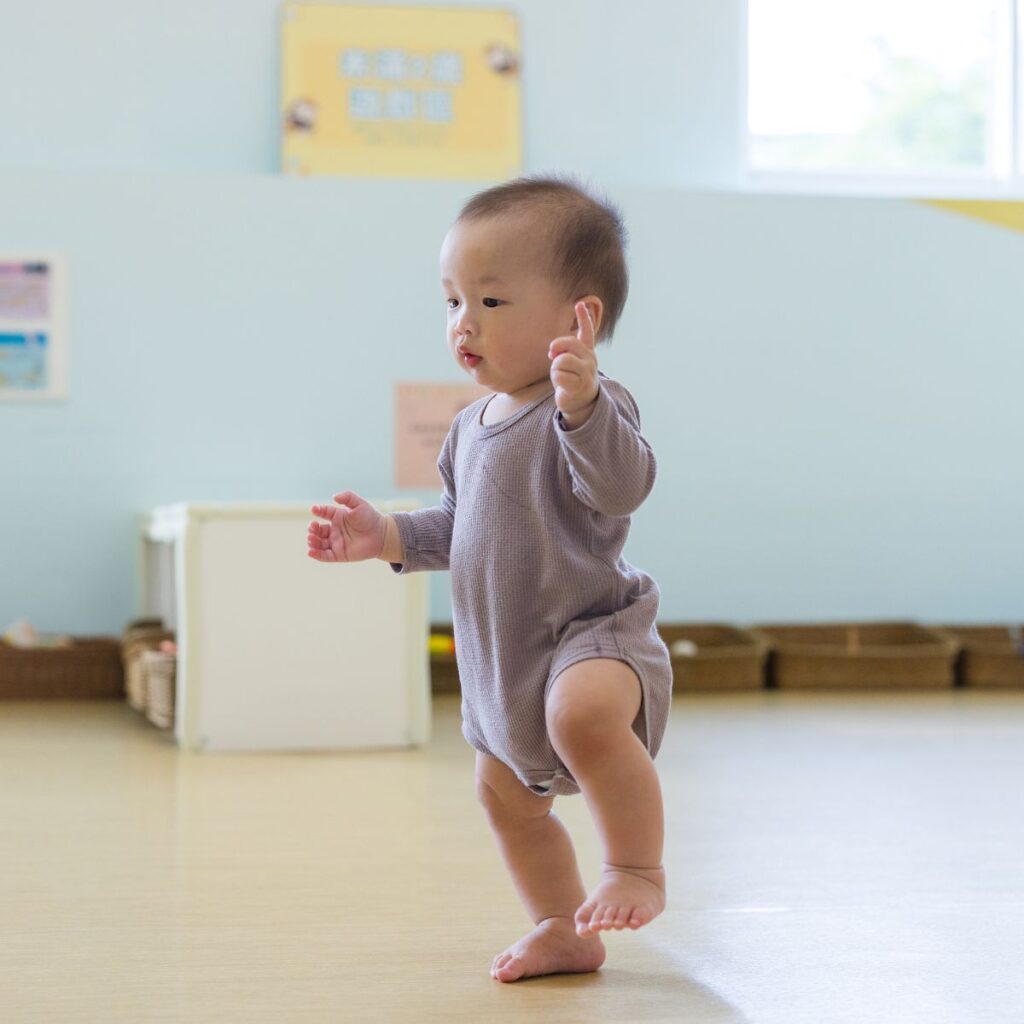
And finally, motor skills are described in terms of their contribution to cognitive development
All the facets of motor skills described above converge towards an obvious application: motor skills serve the understanding of the physical and human environment and the understanding of oneself. For Piaget, human intelligence has its origins in the development of motor skills. By interacting with the world, the child acquires their first knowledge of objects and the physical laws that govern them. In the stages he describes, the sensorimotor stage (from birth to 2 years) is the period during which the child discovers the results of their actions.
More recent research has put the importance of motor skills in the development of intelligence into perspective, by demonstrating all the implicit learning that babies undergo before they are able to manipulate objects or move around (Lécuyer).
By interacting with objects, the child tests hypotheses and is confronted with problems of action planning. Lacking inhibitory control, their actions are often thwarted. Repetition consolidates predictions and allows for better control of movements.
Motor skills are also a key vehicle for learning to communicate. To interact with their peers, young children, before they can speak, will synchronise their movements with those of other children. They will imitate. Nadel’s work emphasises the importance of coordinated movements in human interaction.
And one final question for this interview: how should we take into account the motor development of very young children in their education?
The many different approaches to motor skills force us to recognise the complexity of this function. Animals, like humans, move around. Each species develops a type of motor skill linked to its morphology. Panthers run, kangaroos hop, fish swim and titmice fly…
Human babies are mobile from birth, but they must wait a few months before they can move around independently and handle objects. Initially, their high level of dependence means adults must take care of their basic needs. Gradually, they become observers of their progress. Should adults arm themselves with patience, believing that motor development will proceed inexorably, even without them? Should they support children in their discoveries? In light of all the research cited above, it is clear that the environment plays a significant role in the development of muscle tone, in managing balance, movement, coordination, the planning of motor actions and, above all, in how motor skills help children understand the world through action. Early years professionals therefore do indeed have a role to play in motor development. They must:
– Encourage motor experiences throughout the day (there must be plenty of opportunities to move);
– Teach children inhibitory control (walking along a line, balancing on one foot);
– Allow them to choose their own posture (stability) and not sit a child on a chair too early (before they can do so unaided);
– Provide opportunities for them to interact with their environment through manipulative and construction play;
– Describe the children’s actions to them to build their vocabulary and draw their attention to the results of their actions;
– Do not hold back on encouragement;
– And provide opportunities to move in time to music or rhythms.
End of the second part of this interview
To read part: click here.