


Project: Unraveling Variability in Young Children’s Brain Responses to Various Sensory Stimuli
2025 First Prize for Scientific Research from the “5 Senses for Kids Foundation” in partnership with the Society for Neuroscience
This project was conducted by Marianne Latinus of INSERM, the University of Tours, and the iBraiN Laboratory. The title of her project is “Unraveling variability in young children’s brain responses to varied sensory stimulations.” The work presented is one of the first studies to examine sensory processing in early childhood across three different sensory modalities using an individual-level approach.
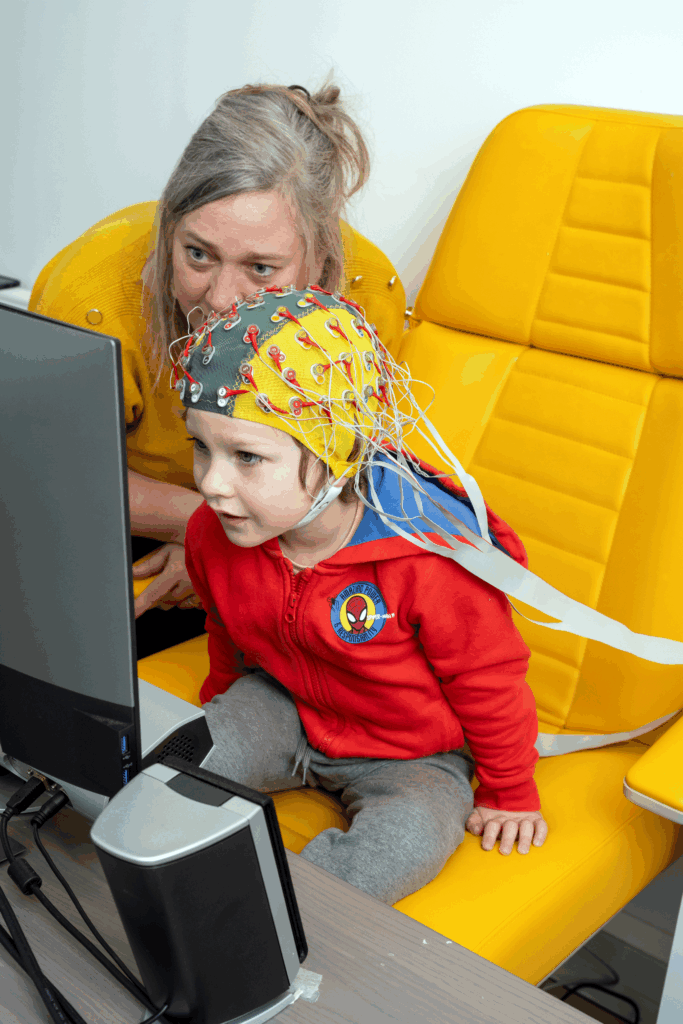
© Inserm / François Guénet
Objectives
The objective of this study is to better understand the variability of brain responses to sensory stimuli in early childhood, a key period of cognitive and social development. We sought to objectively characterize individual multisensory profiles using electroencephalography (EEG)
Project Description
We recorded the brain activity of 23 children aged 2.5 to 5 years and 11 months without neurodevelopmental disorders in response to different types of sensory stimuli: visual, auditory, and somatosensory. These stimuli included both simple (low-level) signals, complex stimuli, and stimuli with social content. The evoked responses (ERPs—evoked potentials) are then analyzed to identify sensory profiles and assess individual differences in the neural processing of stimuli.
Measurement Method
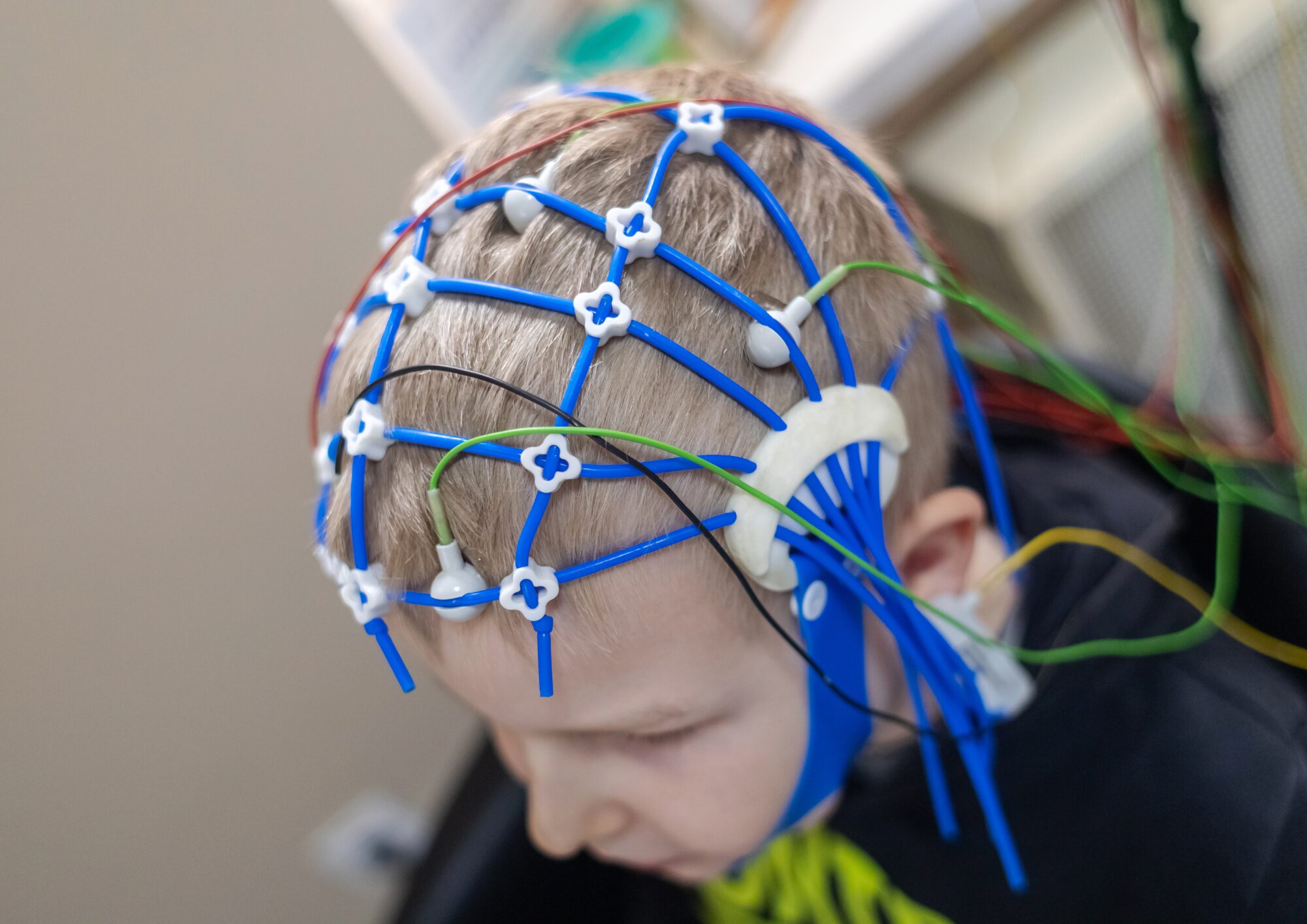
The EEG records the brain’s spontaneous electrical activity measured at the scalp level using a cap fitted with electrodes. The EEG offers very high temporal resolution and has the advantage of being non-invasive and minimally intrusive.
We analyzed the evoked potentials (EPs) obtained after extracting and averaging the responses evoked by each sensory stimulus.
EPs measure the brain response evoked by the presentation of specific stimuli and allow for the study of its temporal course. The EP method is based on the principle of averaging the brain response evoked by multiple repetitions of the same stimulus. This increases the signal-to-noise ratio, i.e., reduces the random variation present in each isolated response—known as noise—and thus increases the portion of the signal corresponding to the brain response specific to the presented stimulus. An ERP is characterized by different components (signal deflections) that serve as indicators of brain activity. Two main characteristics describe these components: latency (in ms), the time interval after stimulus presentation during which the signal deflection appears, and amplitude (in μV), the variation in activity relative to a baseline.
Inter-trial consistency is a measure of the variability of brain responses within the same individual. The principle of EP is based on the idea that the same sensory stimulation produces the same brain response; inter-trial consistency measures the validity of this assumption.
Evoked potentials and inter-trial coherence were measured for each child and for each condition. A cluster analysis was then applied to group children with similar neurophysiological profiles.
Impact / Expected Results
The results revealed the existence of three profiles of children differing primarily in their processing of complex visual and auditory information (e.g., images of instruments, instrument sounds). The different profiles observed do not depend solely on chronological age, but rather on the variability of brain responses, which better capture brain (im)maturity and the efficiency of brain processing. These results contribute to a better understanding of the diversity of neurodevelopmental trajectories.
This study demonstrates that EEG is a powerful tool for assessing children’s developmental profiles, which could be particularly valuable in the study of neurodevelopmental disorders and the monitoring of children with such disorders. This work provides a major scientific foundation for the idea that children develop at different rates and that chronological age is not the only factor, suggesting that these developmental differences should be taken into account in the daily care of children.