


Interview with Cécile MELLARDI – part 2

Hello Cécile MELLARDI.
You are a harpist. Today you also work in a nursery in the Ile de France region.
Why would you recommend the importance of music
from an early age?
It seems to me that access to music is an opportunity. I’m not going to take the place of neuroscientific research, which is full of praise for the importance of music. As a universal language accessible from the very beginning of life, it enables every person to experience a unique and intimate inner moment with what music has to say to them.
Generally speaking, music affects different areas of a child’s development, with many positive effects:
- Emotional expression and regulation: we can see the impact on creativity. Music stimulates the imagination (an invitation to dream) and acts on the physiological state, leading to relaxation or tonicity.
- A means of stimulating the body and cognition: sound makes the body vibrate, rhythm can set you in motion, melodies and songs encourage you to sing along. All this can help with language and motor skills, and develop memory and attention.
- Passing on culture and the arts, and strengthening social ties: listening to or playing music with others brings a group together, creating a shared moment during which everyone listens or plays (sings) together. There’s a shared language, a shared listening experience. These are rare life experiences.
I would add that playing an instrument or singing provides the same virtues on a much broader scale: you use voluntary actions (gestures), organised in the service of a “work”… The necessary acquisitions are numerous (listening, integration by repeating the gesture, the melody, by “tuning in” together, memorisation…).
If we go a step further, we can see that learning is based on different attention capacities, active involvement (effort, emotional regulation, etc.), evaluation capacities (comparing, understanding a “mistake”, etc.) and the automation that enables us to “play” with ease.
Since you work in the nursery with a team made up of nursery assistants, educators and a psychologist, what feedback do these professionals have from the field and how do they identify the impact of your work on a day-to-day basis?
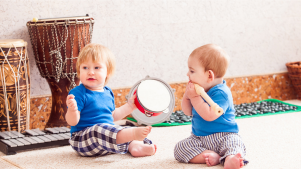
We have 2 musicians (viola and harp) who alternate weekly sessions for 0-3 year olds, divided into one group of 0-1 year olds and two groups of 1-3 year olds. During each 30′ session, we play different music and sing nursery rhymes. Sometimes the older children come along to touch the instrument and play. Here’s what the team had to say:
“It’s really a moment out of time when everyone (children and adults) is available: there’s more contact with the babies, who are more relaxed. The staff can observe and appreciate this. It’s a special moment for the children. The regularity of the visits also creates a bond, anchors them and gives them confidence. It’s a break from the group rhythm, allowing the little ones to connect with their own intimacy. It’s a real moment of self-discovery, with a close connection to themselves and their emotions. Children can discover and experience an intimate dimension that is essential, and welcome their emotional dimension. This suspended moment allows them to stop doing what their bodies tell them to do and listen to the music. For example, when they are feverish, they stop grumbling, they know how to wait for their meal, the various cries of infants subside… It’s as if the music were a “band-aid”, allowing them to “contain” themselves, while at the same time enveloping them pleasantly.
It’s a suspended time for each group, where there’s both individual listening and a dynamic TOGETHER.
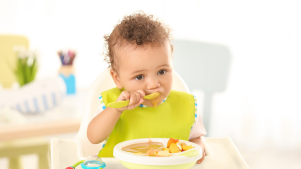
Toddlers have an incredible attention span throughout the session. They are seated in an arc, like at a show, and this is already an anchor. It’s a special time, because even children with high blood pressure can be fully captured. The music encourages listening, bonding, chirping… They try out their voices. As soon as the music stops, some of them grumble and fidget until the music starts again. After the music, the meal is more peaceful… Those who are hungry wait more calmly.
For the older children, the music gives them a calm, soothing moment when they can rest, or sometimes gets them to engage in more motor skills. Nursery rhymes stimulate their language, singing and memory enormously… It’s all about daring to sing, daring to let your voice be heard, recognising a familiar tune, clapping your hands, sometimes dancing, touching the instrument calmly, taking turns, feeling the vibration and welcoming it… They gradually gain confidence and let themselves be touched.
There was a painting workshop with music, and it seemed that the children were much more “concentrated”: the paint was more colourful, and the paper filled in more harmoniously.
There was also an extension of calm beyond the musical moment. Mealtimes seemed calmer after the sessions”
It was also noted that our face-to-face musical interventions had a greater effect than listening to a CD… because of the timbre of the instruments played live, the musical energy of the moment, the contact with us, our looks, our voice..
And to complete the picture, here’s a comment from the psychologist who recounts what she saw during the sessions. “Nicolas (first name changed), a baby of a few months old, seemed “inaccessible” in the relationship, not letting himself go. The musical moments gradually enabled him to gain confidence, to evolve and finally to be himself in a relationship, by allowing himself to let go and daring contact. Music allows him to feel things, to really enter into a relationship, and to be accessible”
These sessions make a real difference to the development of these babies in this nursery, and have become a must for everyone involved.
Music does have the virtue of softening the blow, and brings a little harmony to everyone!

To read the first part of the interview, click here