Project “The facilitating effect of odours on infant vision declines between 4 and 12 months”
1st prize 2024 for scientific research from the “5 senses for kids Foundation” in partnership with the “Société des Neurosciences“
Background and objective of the project
For infants, the so-called “dominant” sense for our species – sight – is still underdeveloped. At birth, visual acuity is very poor and colour vision absent. It will take almost a year for the visual system to reach a level of maturity approaching that of an adult, and several more years to learn to recognise objects in the visual environment quickly and accurately.
On the other hand, the sense of smell – considered to be of little use in humans – develops early and plays an active role in early learning. It has been shown, for example, that the foetus learns the odours it encounters in the amniotic fluid and can recognise them after birth. The smell of the mother, in particular, is a source of familiarity for the infant, who uses it in particular for feeding. This smell, which is so special to young children, serves many other functions during their first months of life, such as stimulating their alertness and reassuring them as they learn new information.
Previous work by our team has repeatedly demonstrated the role of the mother’s smell in the infant’s development. In particular, we have shown that at 4 months, the presence of the mother’s smell improves face categorisation (the ability to quickly recognise that a visual stimulus is a face and not another visual category), a task that is still difficult for the young 4-month-old brain.
In this project, we therefore asked ourselves how this facilitating effect of the mother’s smell evolves over the following months, as the infant learns to recognise faces through the visual channel alone?
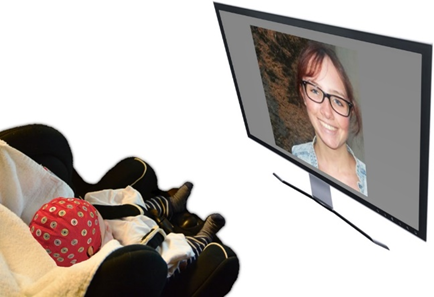
Photo credit Diane Rekow and Arnaud Leleu
An infant in a car seat facing a screen showing a sequence of images containing faces. Its brain activity is recorded by EEG and it is tucked into a T-shirt worn by its mother to diffuse her smell.
Project description and results
To answer this question, we again measured the influence of the mother’s smell on the categorisation of faces for infants aged between 4 and 12 months, this time in order to identify whether the effect of smell depends on visual development.
The infants and their parents were taken to our ‘baby-lab’, which is equipped to analyse the behaviour and brain activity of young children. The latter was used to measure their ability to categorise faces. To do this, we used electroencephalography (EEG), a non-invasive and painless method that involves placing sensors (electrodes) on the infant’s scalp to measure the electrical activity of their brain.
While their brain activity was being measured, the infants viewed sequences of images on a screen. These images represented various categories of objects or animals as well as human faces, which were presented at regular intervals in the sequence. This presentation of faces at a regular rate made it possible to analyse the response of the infant’s brain to this same rate. This response is then a cerebral marker of the ability to categorise the faces in relation to the other categories presented. During the visual stimulation, the infants were alternately exposed to a T-shirt worn by their mother during the 3 nights preceding the experiment, or to an unworn T-shirt that served as a smell control.
As expected, the results initially showed a stronger and more complex brain response to faces between 4 and 12 months of age, indicating a gradual improvement in this ability as the infant grew older. Conversely, the facilitating effect of the mother’s smell, found at 4 months in the form of a stronger response to faces in the presence of this smell, gradually diminished until it disappeared at 12 months. This indicates a gradual decline in the help provided by the mother’s smell, as the infant’s visual system becomes capable of categorising faces on its own. In short, this project shows how the sense of smell assists vision in infants until sight reaches sufficient maturity.
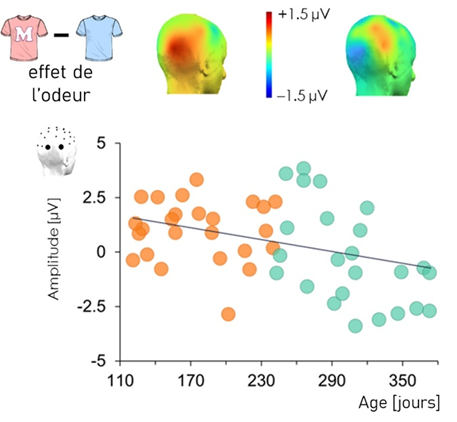
The effect of the mother’s smell (difference between the T-shirt worn by the mother and the control T-shirt) on the brain’s response to faces diminishes between 4 months (110 days) and 12 months (380 days).
Impact of the project
The way in which the senses interact during a child’s development has always intrigued and fascinated scientists. Through this project, we are showing how integration between the senses is useful for the sensory development of the infant, with the more mature senses, such as smell, helping the less developed senses, such as sight, until the latter become capable of recognising the environment on their own. It is therefore important, when supporting the sensory development of young children, to take into account all the senses and their relationships, and not to neglect a sense such as smell, which is so often relegated to second place for young children.