


5 senses for kids Foundation Awards: 4th ceremony
On this Thursday 20 November 2025, we have a special thought for Alain Goetzmann, a wonderful and generous man, who has been by our side since the beginning and who left us this summer. We dedicate this evening to him.
For this 2025 edition, four projects have been rewarded
The 5 senses for kids Foundation 2025 Educational Action Awards
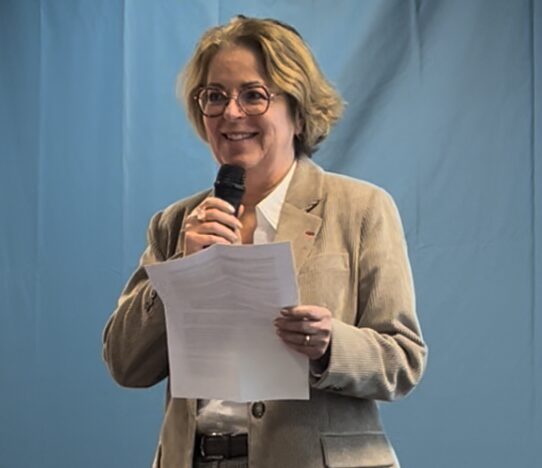
– The first prize of €2,500 was awarded to Laurence Goujon from the Amicale ” Les Corallines “. Her project“De caillou(x) à Mégalithes” (From pebble(s) to megaliths) aims to awaken young children’s interest in local heritage: megaliths, by developing a sensitive approach that builds knowledge. The aim is to forge an emotional link with this magnificent heritage, which is over 7,000 years old, and turn young pupils into “ambassadors” of history, or rather prehistory.
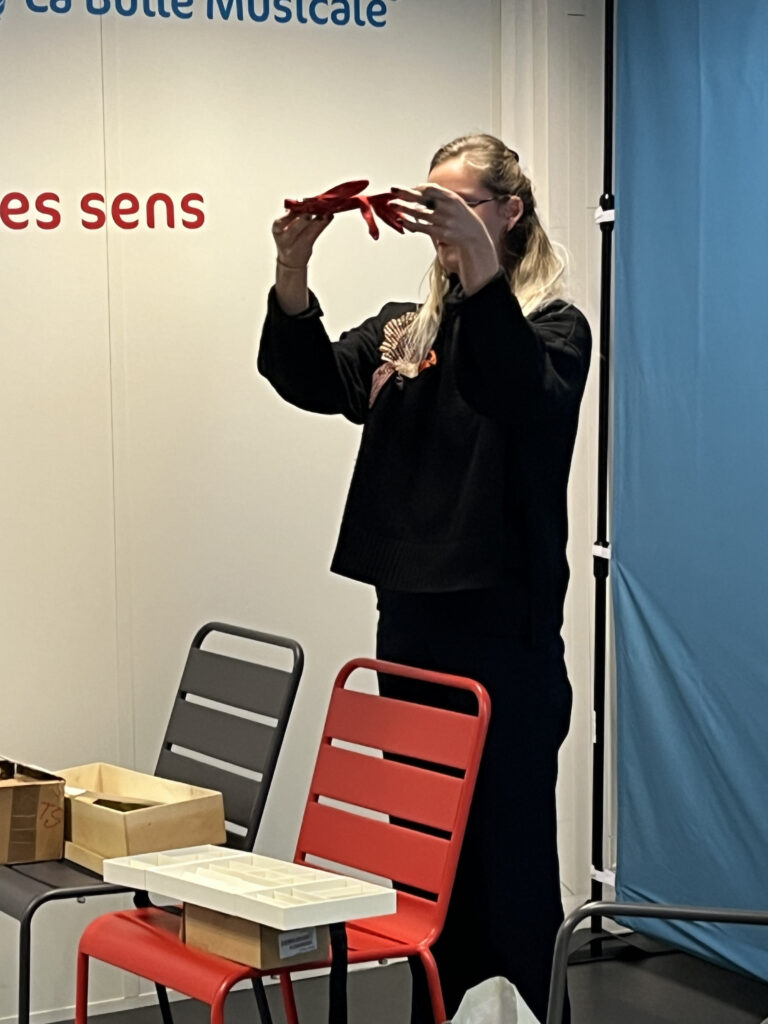
– The second prize of €1,500 goes to Etienne Gaudillere , represented this evening by the actress Marion Lechevallier from the Compagnie Y. In his “Poetry in boxes” project, he invites children to open boxes of different shapes, sizes and materials. Inside each box, they discover a particular object, associated with a poem written on a page that the actor then reads aloud. Some of the poems are funny, others sad, others hard to understand… The time available for the event deliberately does not allow you to open all the boxes, so you have to choose carefully.
The 5 senses for kids Foundation 2025 Science Prizes in partnership with the “Société des Neurosciences”
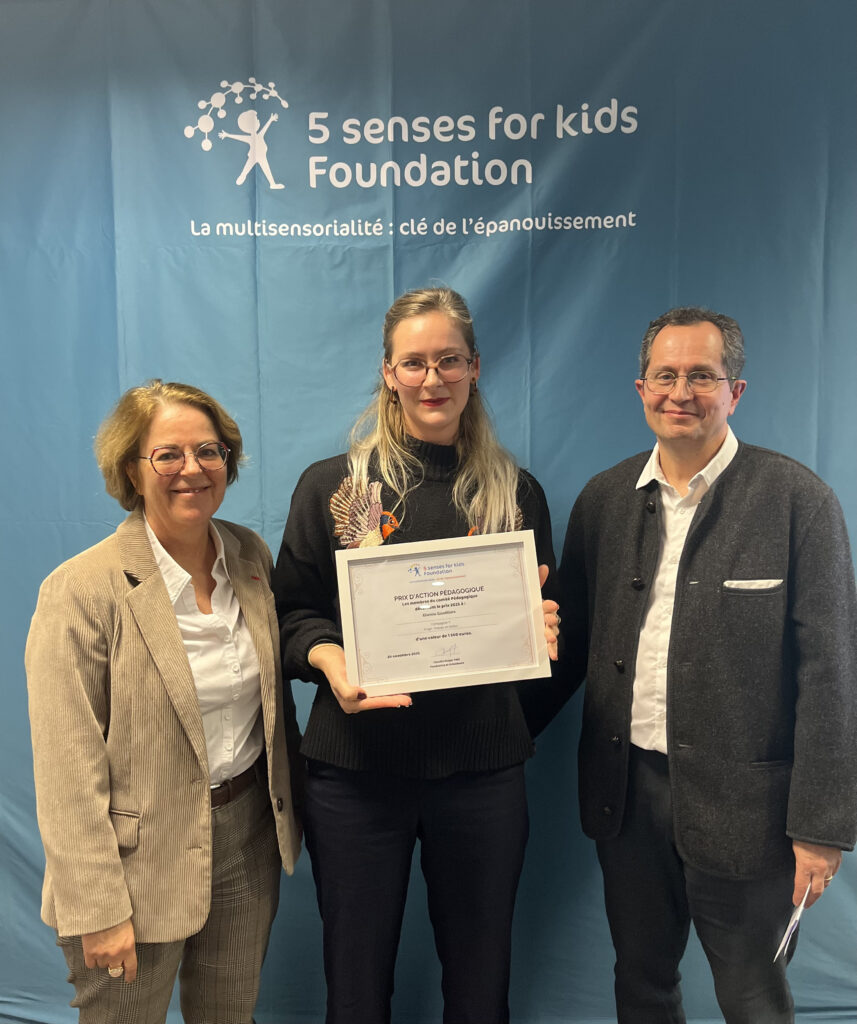
– The first prize of €2,500 goes to Marianne Latinus from INSERM, University of Tours, in the iBraiN Laboratory. The title of her project is “Unraveling variability in young children’s brain responses to varied sensory stimulations”. The work presented is one of the first studies to look at sensory processing in early childhood and in three different sensory modalities with an individual approach. This work demonstrates that EEG is a powerful tool for assessing the developmental profile of children, which could be of particular interest in the study of neurodevelopmental disorders, and the follow-up of children with neurodevelopmental disorders.
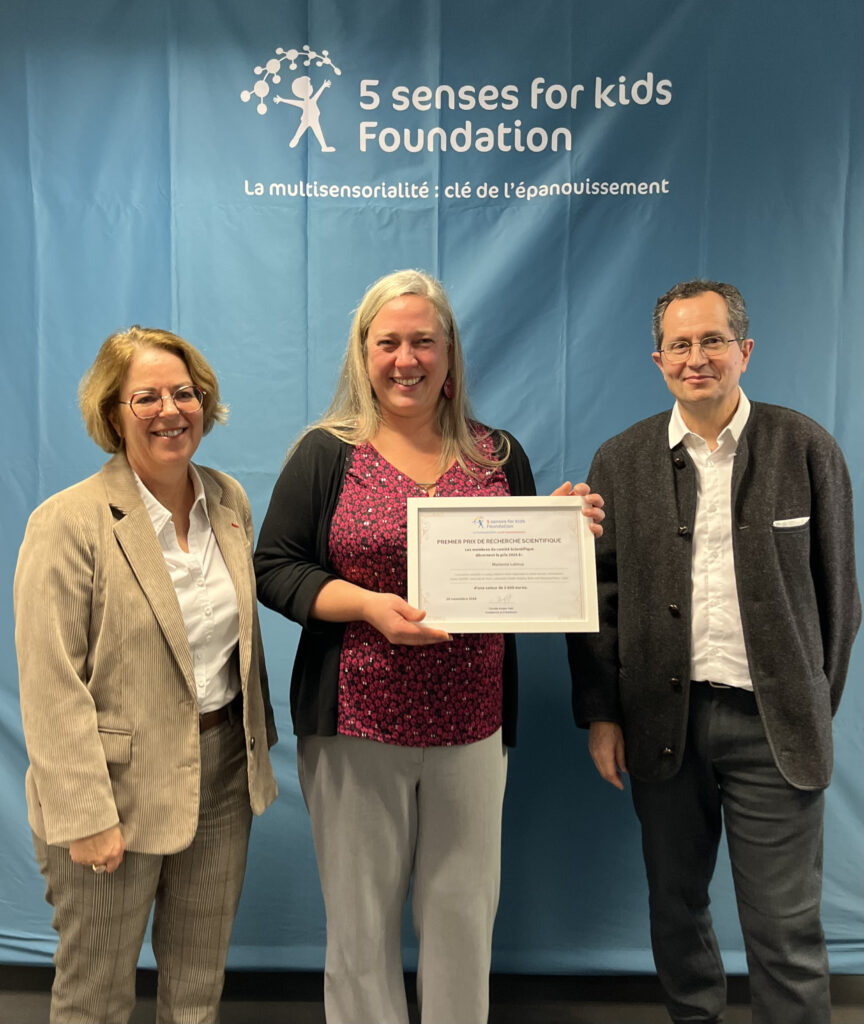
– The second prize of €1,500 is awarded to Jules Dejou – Centre de Recherche en Neurosciences de Lyon (CRNL). NEUROPOP team. “Olfactory memories of childhood” is a study of environmental, behavioural and neural determinants using a translational approach in humans and mice. This work sheds light on the way in which a simple odour can provide a lasting link between emotions, memories and the construction of the self from an early age.
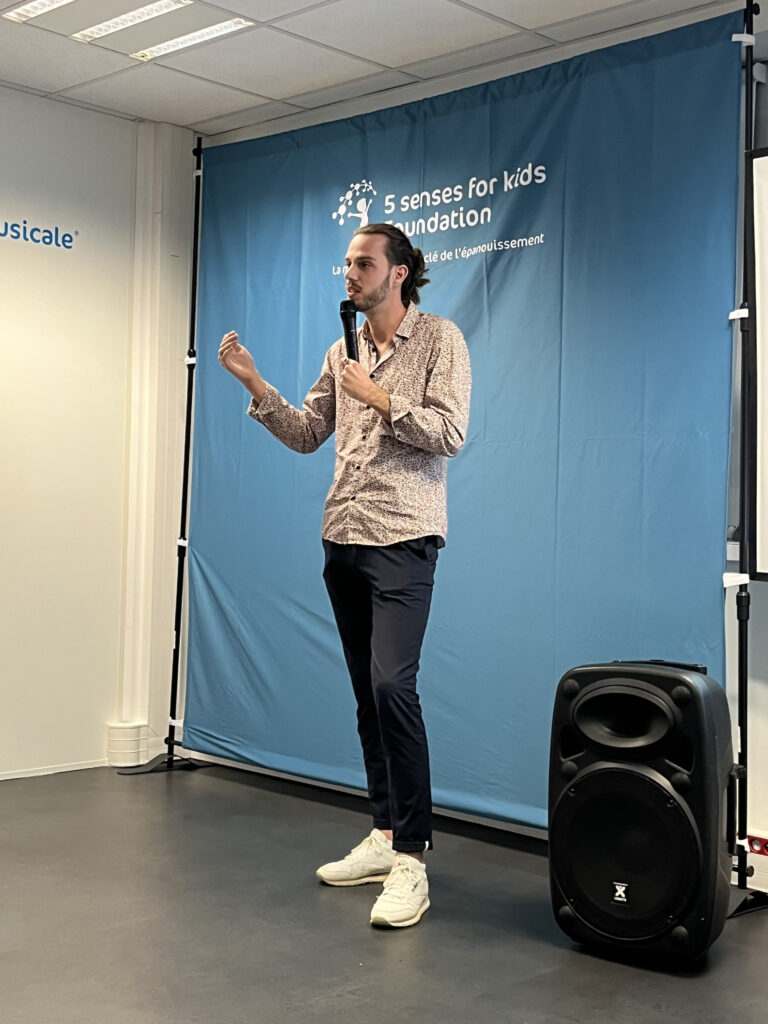
The Founder’s speech
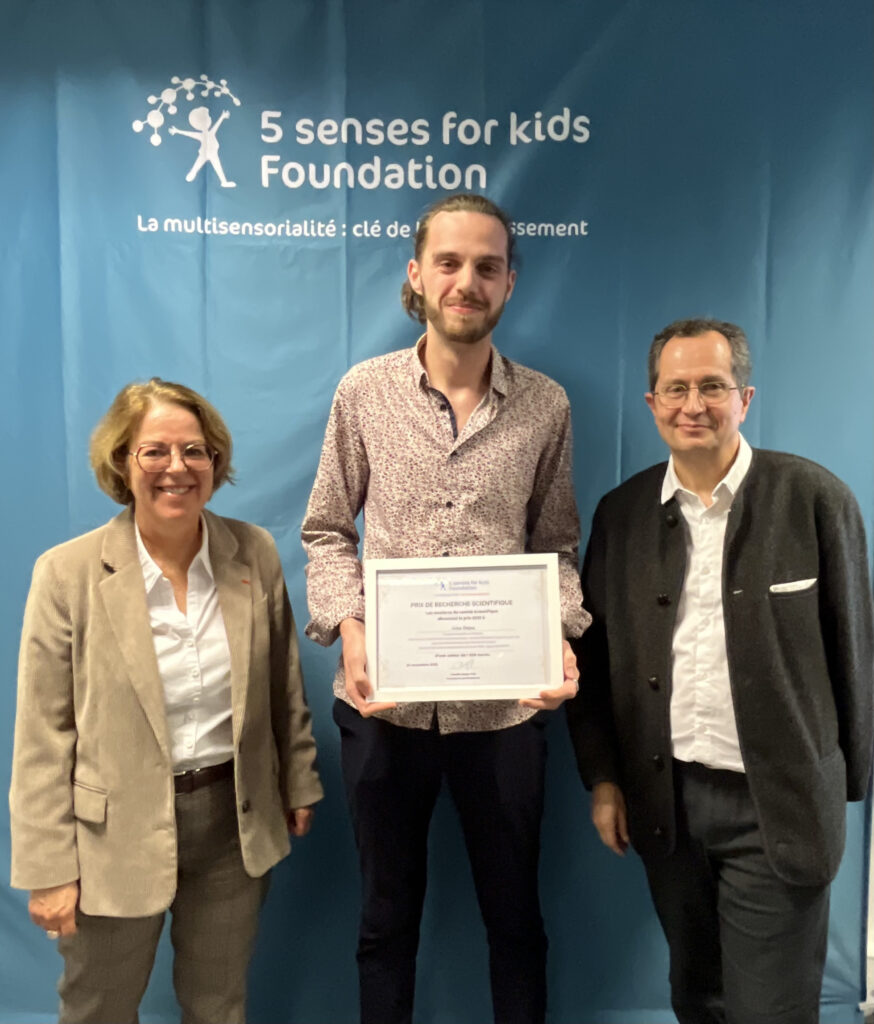
What kind of world will our children live in? The world of artificial intelligence?
Between fascination and concern, we are living in a historic moment where AI is invading everywhere: our homes, our workplaces, our schools. Never before has the boundary between human and machine seemed so tenuous.
On a day-to-day basis, there’s no doubt that AI is an extraordinary tool. It helps us to get organised. It even anticipates our needs! It can solve complex problems and automate repetitive tasks. It can improve service and performance.
The young children for whom we are responsible, as parents or educators, are going to be living in this new world, the contours of which we can barely fathom.
For us, this raises two questions.
The first is time. AI saves us time to do other things. But do we spend the time we save consuming content generated by AI? Or are we spending it enjoying the world with the curiosity and enthusiasm of a child?
We all know that new technologies threaten our attention span. The more time we save, the more we feel we’re running out. By systematically offering us quick answers, they deprive us of many discoveries and above all of the paths that lead to them. Living also means observing, admiring, manipulating, listening, tasting and creating.
The second question is that of education and learning.
How can we continue to learn when the tools seem to think for us? When digital technology facilitates access to knowledge? And why even learn, why even go to school?
Of course, we have to teach our children to use AI, to live with AI, not by AI. But not only that.
Education will have to be more human, more rooted in the living world than ever before.
You might think that everything is now played out in the digital sphere. Quite the opposite is true: the more our environments become virtualised, the poorer our sensitive relationship with the world becomes, the more we need a teaching approach that roots learning in sensory experience, in interaction with reality.
Neuroscience confirms what intuitive teachers knew: knowledge experienced through several sensory channels is better retained and understood.
Before we conceptualise, we experiment. Studying mathematics means experiencing it through shapes and concrete objects. Studying biology and physics means manipulating matter. Studying poetry means reading it, listening to it, and later reciting it. Well done to the Compagnie Y, well done to Marion Lechevallier and Etienne Gaudillere for their “Poetry in boxes” project, which illustrates my point so well.
Multisensoriality is not just a pedagogical fad. It’s about developing irreplaceable human qualities: curiosity, creativity, empathy and critical thinking. It’s what will enable future adults to live in the world, to find their place in it, to understand it, to benefit from it and to improve it, rather than being subjected to it. Above all, it is what enables human beings to connect with the world and with others.
It’s also about connecting with time. To break with the tyranny of immediacy. I’m delighted that two of the projects rewarded this year are part of this approach.
- That of Jules Dejou and the NEUROPOP team from the Lyon Neuroscience Research Centre, our 2nd Scientific Prize. It is fascinating to understand the way in which a smell can create a lasting link between emotions, memories and the construction of the self from a very young age.
- And our 1st prize for educational action, supported by the “Les Corallines” association, which aims to forge an emotional link with heritage and history.
Finally, multi-sensoriality is a promise of inclusion. Every pupil learns differently: some by gesture, some by sound, some by image. By multiplying the number of sensory inputs, we are multiplying the chances of everyone succeeding.
We make diversity not an obstacle, but an opportunity, an educational asset.
Of course, multisensoriality has not yet revealed all its secrets. We need to support all the researchers who will help us to better understand and invent the right educational approaches for future generations. I am delighted that the 1st Scientific Prize has been awarded to Marianne Latinus and the teams from the iBraiN laboratory, for their study of the multi-sensory profiles of young children. I have noted the promise of this research in the field of neurodevelopmental disorders. It’s a subject to which we at Cap Enfants are very committed.
If we want our societies to remain creative and profoundly human, we must defend an education that speaks to the body as much as to the mind. That’s what you are doing, each and every one of you, in your own way. That’s what we’re doing with 5 Senses 4 Kids Foundation.
Because what we learn with our eyes, ears, hands and hearts, no technology can ever take away from us.
Thank you very much.
We are proud of the help we are giving to committed scientific and educational players. This help is only possible thanks to the donations we receive every year.
You can also make donations to support future projects or prizes via the website:
And by supporting “5 senses for kids Foundation”, you also benefit from substantial tax advantages.
In France, every donation is eligible for tax relief:
– If you are an individual, your donation is eligible for a tax reduction of 66% up to a limit of 20% of your taxable income. For example, a donation of €150 entitles you to a tax reduction of €99.
– If you are a company, you are entitled to a reduction in corporation tax of 60% of the amount of the donation, up to a limit of 0.5% of turnover excluding tax. For example, a donation of €1,000 entitles you to a tax reduction of €600.